Articles
AI and the Future of Vector Graphics
Why Human Design Still Matters
Artificial intelligence is no longer an experimental feature sitting outside the professional design workflow. It is becoming part of the tools designers already use to create illustrations, icons, patterns, color variations, and production assets. In Adobe Illustrator, generative features can turn prompts into editable vector scenes, fill shapes with new artwork, produce patterns, extend compositions, recolor designs, and transform visual concepts into vectors.
This changes the economics and speed of vector production, but it does not make design judgment obsolete. AI can generate options quickly. It cannot automatically guarantee that those options are original, coherent, technically clean, suitable for a brand, or ready for real commercial use. As generation becomes easier, the ability to select, refine, organize, and finish vector artwork becomes more important.
The future of vector graphics is therefore unlikely to be a contest between humans and machines. It will be a hybrid workflow in which AI accelerates exploration while designers remain responsible for meaning, consistency, technical quality, and final decisions. The amount of vector content will grow dramatically, but the difference between disposable output and valuable design will become easier to see.
The Change Is Already Here
For many years, automation in vector software focused on predictable operations such as tracing, alignment, shape building, simplification, and color replacement. Generative AI introduces a different type of assistance. Instead of only executing a defined operation, the software can propose visual content from a description, reference, selection, or existing composition.
A designer can now use AI to explore a rough concept before drawing it manually, build variations of existing vector illustrations, test several directions for a campaign, or generate supporting objects for a larger scene. This is especially useful at the beginning of a project, when the goal is to discover possibilities rather than perfect every anchor point.
The speed is significant. Tasks that once required hours of sketching can produce visual starting points in minutes. Clients can see more directions earlier, creative teams can compare alternatives, and independent designers can test ideas that would previously have been too expensive to develop. AI reduces the cost of exploration, but exploration is only one part of professional vector design.
What AI Does Well
Generative systems are strongest when the brief allows variety. They can create broad stylistic options, unexpected silhouettes, decorative details, palette ideas, and multiple arrangements of familiar subjects. They are useful for mood boards, early sketches, background elements, pattern experiments, and rapid visual research.
AI can also help a designer overcome the blank canvas. A generated result does not need to be accepted as a finished asset to be useful. One variation may suggest a better composition, another may offer an interesting color relationship, and a third may reveal a shape worth redrawing. Used this way, the system acts as a source of raw material rather than an automatic author of the final work.
Repetitive production tasks are another natural area for automation. Creating numerous colorways, filling a predefined silhouette, extending a decorative scene, or producing concept variations can be faster with generative assistance. This gives designers more time for art direction, communication, and refinement, which are often the parts of the process that determine whether a design succeeds.

Why Generated Vectors Still Need Repair
A vector file can look convincing at normal zoom and still be poorly constructed. This distinction matters because buyers do not purchase only a preview image. They expect artwork that can be edited, recolored, scaled, separated, animated, printed, or integrated into another project.
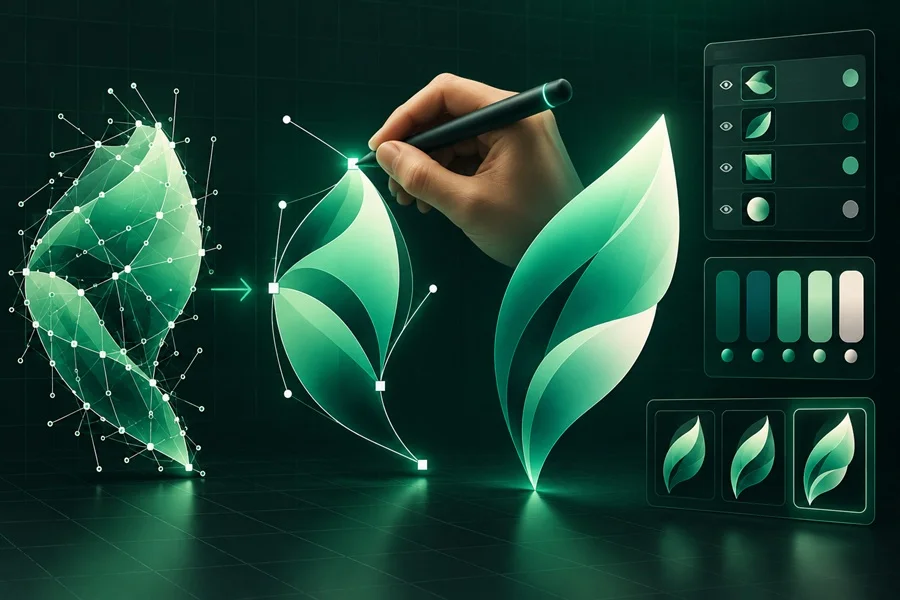
AI generated vectors may contain excessive anchor points, uneven curves, open paths, hidden objects, unnecessary clipping masks, accidental overlaps, duplicated shapes, or groups that do not reflect the visible structure. A simple leaf may be built from many fragments when two clean paths would be enough. A smooth circle may appear correct until it is edited and its irregular geometry becomes obvious.
The problem becomes more visible in structured products such as SVG icon packs. Every icon in a professional set should follow the same grid, optical weight, corner treatment, stroke logic, perspective, padding, and level of detail. An AI system may create attractive individual icons while failing to maintain those rules across the entire collection.
Text, symbols, hands, repeated elements, geometry, and spatial relationships can also expose generation errors. Even when the artwork is technically editable, it may not be logically editable. A designer must decide which shapes should remain separate, how objects should be grouped, where paths should be simplified, and what the customer is likely to change.
Generic Content Will Become Abundant
The easiest vector categories to generate will probably experience the greatest increase in supply. Generic arrows, decorative blobs, simple business scenes, isolated objects, abstract backgrounds, and common interface symbols can already be produced in large numbers. As tools improve, the visual baseline will rise while the market price of undifferentiated content may fall.
This does not mean that these categories will disappear. They remain useful, and buyers will continue to need them. The change is that basic availability will no longer be a strong competitive advantage. A file will need to offer something more specific: a distinctive style, a carefully planned system, unusually strong execution, a complete collection, or exceptional technical preparation.
Quantity alone will become a weaker strategy. When thousands of creators can generate hundreds of acceptable images, publishing more of the same will not solve discoverability. Curation will matter more. A focused collection that solves a real design problem can be more valuable than a large group of loosely related assets.
Human Craft Becomes More Visible
Handcrafted vector design is sometimes described as valuable simply because it takes longer. Time alone is not the source of value. The value comes from intentional decisions that remain consistent from the first sketch to the final export.
A designer decides what to remove as well as what to add. Good vector artwork often depends on reduction: fewer points, clearer silhouettes, controlled negative space, deliberate rhythm, and a visual hierarchy that remains understandable at different sizes. These decisions require awareness of the purpose of the image and the context in which it will appear.
The same principle applies to reusable vector elements. A customer should be able to combine, resize, recolor, and reorganize the components without discovering broken masks or confusing groups. Thoughtful construction is part of the product, even though it is not always visible in the preview.
Human craft also provides accountability. Someone has checked the proportions, corrected the curves, considered the license, named the files, selected the formats, and made sure that the asset works outside the image used to advertise it. In a market filled with instant output, that reliability becomes a meaningful promise.
Original Style Matters More Than Ever
AI is extremely effective at reproducing broad visual conventions. It recognizes what a modern gradient icon, flat business illustration, retro poster, or playful cartoon usually looks like. This makes established styles easier to imitate and causes many generated results to converge around familiar visual patterns.
A personal style is more than a surface treatment that can be described in a prompt. It grows from repeated choices about proportion, shape language, color, texture, pacing, humor, subject matter, and composition. It also evolves through mistakes, experiments, cultural references, and years of practical work. These relationships are difficult to reduce to a single instruction.
Designers who develop a recognizable visual language will have a stronger position than those who depend entirely on whatever style a model produces by default. AI may help extend an established direction, but the direction still needs an author. The more generic generation becomes, the more valuable coherent authorship may feel to clients and audiences.
Consistency Becomes a Premium Feature
A single attractive image is easy to generate. A system of fifty assets that look as if they belong together is much harder. Commercial design frequently requires families of illustrations, icon libraries, product graphics, social media templates, and campaign materials that remain consistent across many scenarios.
Consistency requires rules. Line widths must respond correctly to scale. Characters need stable anatomy and proportions. Light sources, perspectives, palettes, and levels of detail need to match. New assets must expand the system without appearing copied or disconnected. The designer must also know when optical correction is more important than mathematical uniformity.
Generative tools will improve at maintaining references and styles, but professional review will remain necessary. A model can approximate consistency a designer defines what consistency means for a particular brand or collection. That difference is small in theory and decisive in production.
The Role of the Vector Designer Is Changing
The designer of the future may spend less time constructing every early option and more time directing a larger field of possibilities. This does not reduce the need for skill. It changes where skill is applied.
Prompting may be part of the process, but it is not the whole process. The more valuable abilities are defining the problem, choosing references responsibly, recognizing weak output, combining useful fragments, redrawing important areas, maintaining a visual system, and knowing when generation is slower than direct manual work.
In this role, the designer behaves partly like an art director and partly like an editor. AI produces possibilities the designer establishes the criteria. The machine can generate many answers, but it cannot independently determine which answer best serves a brand, audience, interface, print process, or commercial objective.
A Practical Hybrid Workflow
A productive AI assisted workflow begins with a clear brief rather than a prompt. The designer defines the audience, purpose, format, style boundaries, required elements, and technical constraints. Generation is then used to explore specific uncertainties instead of replacing the entire process.
• Define the design problem. Decide what the asset must communicate, where it will be used, and what technical requirements it must satisfy.
• Generate focused options. Use AI for composition studies, silhouettes, supporting objects, patterns, or color directions rather than asking for an undefined finished masterpiece.
• Select with intention. Judge results against the brief, not only against visual novelty. Reject options that are inconsistent, derivative, confusing, or difficult to repair.
• Rebuild important geometry. Simplify paths, correct proportions, redraw focal areas, establish grids, normalize strokes, and remove unnecessary objects.
• Create a coherent system. Apply a controlled palette, naming structure, grouping logic, perspective, and level of detail across every asset.
• Test real use cases. Check the design at small and large sizes, on light and dark backgrounds, in print and on screen, and after common edits.
• Prepare professional delivery. Export the correct formats, verify SVG behavior, inspect transparency, include useful previews, and document licensing clearly.
This workflow uses the speed of AI without transferring responsibility for the result. It also prevents a common mistake: spending more time repairing unsuitable generated artwork than it would have taken to draw a cleaner solution directly.
What Changes for Stock Graphics
Stock platforms and independent asset stores are likely to receive much more AI assisted content. This will create opportunities for creators who can build useful products efficiently, but it will also increase duplication, visual similarity, and pressure on moderation systems.
Buyers may become more cautious about files that look impressive in a thumbnail but are difficult to edit. Clear previews, accurate descriptions, organized source files, relevant formats, and reliable licensing will help distinguish professional assets from mass generated uploads. Technical quality can become part of the brand rather than a hidden production detail.
Complete solutions may perform better than isolated images. A coordinated icon family, a consistent illustration series, or a flexible kit gives the buyer more value than a single attractive generation. Designers who understand real production needs can package assets around workflows instead of publishing disconnected results.

Copyright and Commercial Confidence
AI generated content introduces questions about authorship, training data, similarity, and commercial rights. The answers vary by country, platform, model, and license, and the legal framework continues to develop. Designers should avoid presenting uncertain claims as universal rules.
One useful principle is that human creative contribution matters. In the United States, current copyright guidance distinguishes between material produced automatically from prompts and work in which a person contributes protectable expression through selection, arrangement, transformation, or substantial creative modification. Other jurisdictions may apply different standards.
For commercial vector products, maintaining a documented workflow is sensible. Keep source files, sketches, intermediate versions, references, generation records when appropriate, and evidence of meaningful manual development. Use tools whose terms are compatible with the intended market, and review each marketplace policy before submission.
This is another reason manual work retains value. It does not automatically resolve every legal question, but it can make the creative contribution clearer and the finished asset more distinct. Customers also benefit when the creator can explain how a product was made and what its license permits.
Skills Designers Should Develop Now
Traditional vector skills remain relevant because generated output still needs evaluation and correction. Designers should continue learning shape construction, the Pen Tool, curve control, typography, color, composition, grids, optical balance, file organization, print preparation, and SVG optimization.
At the same time, several higher level abilities will become more important. Art direction helps transform vague possibilities into a coherent result. System thinking supports large families of assets. Visual research helps distinguish inspiration from imitation. Technical literacy makes it easier to judge whether a file is genuinely scalable, editable, accessible, and efficient.
Designers should also learn when not to use AI. A simple geometric icon may be faster to construct manually. A tightly controlled logo may require original sketching and careful reduction. A sensitive brand project may need stricter confidentiality or provenance. Tool choice should follow the design problem rather than fashion.
Will Handcrafted Vector Art Disappear
Handcrafted vector art is unlikely to disappear, but its position in the market will change. Routine production will become more automated, just as earlier software automated typesetting, color separation, tracing, and layout operations. The craft survives by moving toward the decisions that automation cannot reliably make on its own.
Some customers will choose speed and low cost. Others will pay for originality, control, consistency, collaboration, and confidence. Many projects will combine both approaches. A designer may generate a rough scene, redraw the central characters, build a custom icon system manually, and use automation for secondary variations.
The distinction between AI made and human made may also become less useful than the distinction between careless and carefully directed work. A manually drawn asset can be generic or poorly constructed. An AI assisted asset can involve substantial human judgment and craftsmanship. What matters to the buyer is whether the final product is useful, distinctive, trustworthy, and professionally prepared.
The Future Is Hybrid
AI will make vector generation faster, more accessible, and more abundant. It will lower the barrier to producing a plausible image, but it will not remove the need for design expertise. Instead, it will move professional value away from basic production and toward direction, selection, refinement, systems, and accountability.
The strongest vector designers will not be those who reject every new tool or publish every generated result. They will be the ones who know what to automate, what to draw manually, what to rebuild, and what to discard. They will use AI to expand exploration while protecting the clarity and integrity of the final work.
Vector graphics has always evolved with its tools. Generative AI is a major step in that evolution, but the purpose of design remains human: to communicate an idea clearly, solve a real problem, and create something worth using. The machine can accelerate the journey. The designer still decides where it should go.